Rise of AI Conference 2023
May 10, 2023 | 08:30 - 19:30


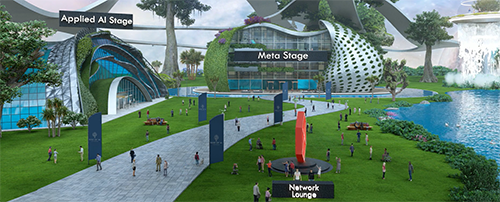

Click the join button to view Opening Keynote and welcome by your host Fabian Westerheide. An international perspective on the most powerful AI Keynote by Prof. Dr. rer. nat. Sabina Jeschke Panel about: - What are the key ingridients to be future proof? - Do we dare to take on technology leadership in Europe? - How do we move from thinking to action? Artificial intelligence (AI) is the study of intelligent agents that perceive their environment and compute predictions about the future states of the environment (“machine learning”) in order to automatically take actions in the environment that achieve their goal. While the first practical work on AI started right with the advent of computers in the early 60’s of the last century, methods of AI have now found wide-ranging applications in all parts of society. In this talk I will focus on the role that energy plays for AI and AI plays for energy; I believe that an energy-aware perspective is imperative for developing true artificial intelligence and that an AI-first approach is imperative for solving the challenge of transitioning to a sustainable future based on renewable energy. Up until today, the primary focus of research on AI methods has been on predictive accuracy and its dependence on the amount of training data rather than the amount of energy that is necessary. However, going forward, data is (typically) abundant for many tasks but energy is becoming a limiting and economical factor. Not being energy-efficient in AI algorithms is not sustainable in the long term, in particular as the amount and dependence on AI methods in people’s life is only going to increase while the amount of energy that is available to society remains constant. Keynote by Björn Bringmann While the excitement around recent advancements in AI and in particular with respect to Large Language Models has never been higher, concerns around privacy, their exponential increase in energy consumption and the associated costs have intensified as well. However, when looking at everyday high-volume use cases like search and recommendations, it is not the most powerful model or the highest company valuation that creates value for everyday people. These users rather care more about finding great content without searching for hours, and staying in control of their data, while the organizations serving them are looking to achieve this at scale in an affordable and sustainable way. Panel Moderator: Johannes Otterbach Trust is a relationship between peers – we choose not to micromanage others we believe are unlikely to work against our interests. AI is a system of techniques for creating artefacts capable of operating without our direct control, but how do we know which such artefacts will work in our interests? In this talk I start at the level of the artefacts and move up, considering cybersecurity, provenance, local and transnational corporations, as well as national and transnational regulators. I will show how the proposed EU regulation is intended to provide transparency and enforcement so everyone and everything in the AI digital economy is more likely to work to our mutual benefit, and discuss what could possibly go wrong. People's brains need much more than the current user interfaces of AI solutions offer. The neuropsychological decision-making process of humans will be explained, and, using real-world examples, what AI solutions must offer humans beyond the AI machine so that the brain stem, the head of 98% of all decision-making processes, gladly accepts these solutions. Artificial Intelligence and Machine Learning provide powerful tools to tackle climate change and support a livable future within our planetary boundaries. While not a silver bullet on its own, there are numerous opportunities for AI to support the more efficient use of resources and help adapt to a changing planet. Recent generative models can further inspire and raise awareness for sustainability and climate action. This talk gives examples from research and industry, highlights some recurring themes and trends, and provides insights into how to successfully leverage the potential of AI in the context of sustainability. Keynote by Prof. Dr. Jürgen Schmidhuber Are you still streaming? Then enjoy the final & closing words. Click the join button to view Moderator Applied AI Stage: Gary Abela Abstract: Natural Language Processing (NLP) refers to building machines that can understand and respond to voice data with their own text and speech. Natural Language Processing falls under the umbrella of Artificial Intelligence (AI) and recent models like the Bidirectional Encoder Representations from Transformers (BERT), Generative Pre-Trained Transformer 3 (GPT-3) and Pathways AI Language Models (PaLM) have made accurate human-machine communication possible. To Accelerate the digital transformation and to gain a competitive advantage for grow, businesses must develop digital-first business models to fundamentally transform how they deliver value to customers. This requires leveraging their trusted data by adopting digital technologies to re-engineer, automate and infuse intelligence into their end-to-end processes. Join us to hear how customers are designing and scaling smarter experiences to simplify their processes and reach their customers in new ways with AI. by Baran Avinc Learn how brighter AI can help you be compliant and improve your operational efficiency By leveraging deep neural networks trained on massive amounts of data, generative AI can create entirely new content, ranging from images and music to text and even code. The impact of this technology can already be seen in consumer industries such as advertising, gaming, and music. Now generative AI is emerging as a powerful tool for various industries and business processes, enabling businesses to create unique and customized content, automate tasks, and enhance decision-making processes. Learn about SAP's thoughts on AI strategy and the future of AI in business. Measuring the impact of AI projects in terms of sustainability is of highest actuality. One the one hand, AI projects are initialized to have a positive effect in one or multiple dimensions of sustainability - economical, social or/and environmental – and thus impacting a multitude of industries, examples ranging from minimizing food waste to optimizing the power grid with increasing decentralized renewable sources of energy. On the other hand, realizing such AI projects requires a substantial amount of energy due to training, data processing and implementation. Consequently, precisely measuring these (ecological) negative effects is essential to proof the undoubtedly positive effects of AI projects. The presentation will concentrate on the approach how to monitor the ecological footprint of AI projects through the full project cycle - from planning over implementation and training to the long term effects caused by continuous model integration - and put this into context with the positive impact of the AI project. This conference talk will explore the topic of embodied AI, which describes the integration of artificial intelligence into a physical entity like a robot, allowing it to interact directly with its environment. The talk will explore the current state of embodied AI, its limitations, and the potential impact it may have on society. I will mainly talk about the e-Check project in which we successfully implemented a large scale inspection use case. I will talk about the challenges in interfacing with establishing equal safety as well as a company like deutsche Bahn for an SME like us. People might learn about what’s practically possible as well as the need and possibilities of data acquisition. Data Poisoning: Recognizing the Poisoned Apple and Mitigating Risks for ML Applications ML models are only as good as the quality of the data and its classification when trained. This creates a host of new options for attackers to influence models in a desired direction through targeted data contamination - also known as data poisoning. This situation is complicated by the complexity of ML applications and architectures in practice. In addition to the large attack surface within the system architecture, there are also numerous points where data can become the poisoned apple for ML models and training due to disruptions in the data supply chain. The presentation will use practical examples to show the points of attack for data poisoning and provide advice on how to minimize the risk. Deep tech capabilities seem to provide fabulous solutions for intelligence and defense. Yet their application in these fields is seriously lagging behind. The talk will provide an in-depth view of why that is the case and what should be done about it. Emotions can rise high when it comes to how emotion artificial intelligence is used in our lives, and it can be even more sensitive when it comes to using it in government defense and security. Rana will talk about voice-based emotion analysis and its use in security services -from predicting duress, fraud, or PTSD to coaching participants to interact in a specific way in meetings or interviews or building surveillance independent of language. He will explain why AI-driven emotional analysis is increasingly sophisticated, the ethical dilemmas involved, how organizations can calculate the risks and rewards of investing in emotion AI, and why committing to transparency is key. 45 Minute private discussions. - Only in Berlin for live guests - Join following Topics and more: In this workshop, you will get an overview of the European Union's regulatory plans related to artificial intelligence systems. You will learn how to meet the legal requirements of this new law. During the workshop, the audience will see and discuss an AI-based sustainability-model for procurement. This calculates in real time the outcome of financial costs and CO2-emission using footprints (CO2, costs, etc.). A planner can simulate all parameters ("what-if") in sandboxes and finally decide which of the scenarios fits the best. An optimization engine can be included to find the optimal path for being sustainable versus saving costs.
Meta Stage Live Stream
 May 10, 2023 10:00
Meta stage live stream
May 10, 2023 10:00
10:00 - 10:30 Welcome & State of AI 2023
An overview about the global AI landscape; review what has happened and outlook AI trends 2023.
May 10, 2023 10:30
How Universal are Foundation Models?
May 10, 2023 11:00
The Future Unlocked: AI and Quantum Computing Transforming the Digital Landscape
May 10, 2023 11:45
Can Germany be a technology leader in AI?
May 10, 2023 14:00
Artificial Intelligence and Engery
May 10, 2023 14:30
AI in Europe - the good news
May 10, 2023 15:00
Responsible AI on the road to carbon neutrality: Leveraging energy-efficient Natural Language Processing in Public Service Media
In this talk, Leif-Nissen Lundbæk and Andreas Grün will explore how to put AI firmly in the service of the general public, by prioritizing data privacy, energy efficiency and public value like diversity, transparency and serendipity, while providing millions of people with personalized fresh and relevant content every day - moving from big to small data and large to small language models that could run on a mobile phone instead of the latest super-computer.
May 10, 2023 15:45
How to Create and Grow AI Ecosystems
May 10, 2023 17:00
No one should trust AI: How and why we govern production of intelligent artefacts
May 10, 2023 17:30
Reduce fear of AI with neuropsychology
May 10, 2023 17:45
Let's give AI some Hope
May 10, 2023 18:15
Thoughts on AI
May 10, 2023 18:45
Closing Words
Applied AI Stage Stream
May 10, 2023 10:30
Applied AI stage live stream
May 10, 2023 10:30
How Bias Impacts AI
This presentation provides an overview of the current facial recognition landscape, with a focus on the impact of demographic differentials and the necessity for bias mitigation in the development and application of facial recognition technology. The various categories of bias will be explored and the implications of these biases on fairness and accuracy will be explained. In addition, a variety of factors contribute to bias in facial recognition will be examined and we will explore how these disparities observe red shape the industry. Shaun will discuss potential strategies for bias mitigation, including data augmentation, diverse representation in training datasets, and more robust evaluation metrics to encourage the development of more inclusive and reliable technology for all.
May 10, 2023 11:00
AI for a Better World: Generative AI to Drive Impact and ESG Advancement in Enterprises
May 10, 2023 11:30
How you could use AI to catalyse Sustainability
May 10, 2023 12:00
Multimodal Contrastive Learning
May 10, 2023 14:00
Globally Sourced Data for AI Training: The How-To of Ethical and Compliant Collection
At brighter AI, we provide image & video anonymization solutions based on state-of-the-art deep learning technology. Our solutions, Precision Blur and Deep Natural Anonymization (DNAT), redact faces and license plates and help you comply with data protection regulations such as the GDPR.
We enable companies in various industries to use publicly-recorded camera data for analytics and AI. With our solution, you can mitigate your liability and the risks of being fined, increase the capacity of your teams, improve your time to market, and push innovation.
May 10, 2023 14:30
Generative AI for Industries
May 10, 2023 15:00
Quantifying sustainability impact during the lifecycle of an AI project
May 10, 2023 15:30
Embodied AI: How will it define our future?
We will begin by discussing whether AI can help in the development of embodied AI by providing the intelligence necessary for the robot to interact with its environment. We will also investigate the question of whether physical limitations are still valid in the age of embodied AI, as the integration of AI into robots could overcome these constraints.
Additionally, we will delve into the potential risks of giving AI a physical interface, such as concerns about safety and privacy. We will also discuss the different types of physical interfaces for AI that exist today, from robots to drones and autonomous vehicles. The talk will also cover the ethical and societal implications of embodied AI and the importance of creating responsible products.
Overall, this talk aims to give a comprehensive overview of the current state of embodied AI and its potential impact on society while highlighting the need for fair and responsible development.
May 10, 2023 16:30
AI enabling automated maintenance for safety critical mobility operations - a frontline report
May 10, 2023 17:00
Hacking AI - the Cybersecurity Challenge in AI Industry
May 10, 2023 17:30
Deep tech capabilities in intelligence and defense - myths, mysery and miracles
May 10, 2023 18:00
Reading the Signals People Use to Communicate their Emotions
Only in Berlin
May 10, 2023 09:00
AI Topic Tables
May 10, 2023 15:30
AI Deep Workshop - How to get your AI compliant under the new EU AI Act?
We will look at which systems fall under the scope in the first place, who exactly has to comply with these requirements, how artificial intelligence is defined by the EU, how exactly the risk-based tier system under the AI Act is designed and which types of AI are to be completely banned. In addition, you will learn which transparency and information requirements will apply according to the EU's ideas.
May 10, 2023 14:00
AI Deep Workshop - How technology can help companies to find a way to net zero

.svg)